

v2606: New and improved solvers and physics
TOP
OpenFOAM currently offers several widely used RANS turbulence closure models, e.g. SpalartAllmaras, kEpsilon variants, and kOmegaSST. Each model has its strengths and weaknesses, and the most appropriate choice for a given application is often determined by running multiple models against a subset of the potential flow configurations.
However, switching between models can force users to trade accuracy between flow classes, e.g. between boundary layers and free-shear flows, and this often complicates workflows.
To improve workflow flexibility, the Generalised k-omega Two-Equation Turbulence Model (GEKO) has been identified as a promising generic RANS closure and has been implemented based on the work of Menter & Matyushenko, 2025 for both incompressible and compressible applications.
GEKO consolidates the two-equation turbulence models into a single framework by providing four independent free coefficients that target different physics:
CSEP: to optimise flow separation from smooth surfaces, such as boundary layers.CNW: to optimise flows in non-equilibrium near-wall regions, such as heat transfer and skin friction.CMIX: to optimise spreading rates for free flows.CJET: to optimise round jet flows.
The implementation provides:
- Wall-distance-free variant (
wallDistanceFree). - Production limiter for
k(productionLimiter, default on). - Kato-Launder stagnation correction (
katoLaunder). - Dilatation correction in the Reynolds stress tensor (
dilatationCorrection). - Four calibration coefficient fields –
CSEP,CNW,CMIX,CJET– each readable as a uniform scalar or spatial field, with optional diagnostic output viawriteCalibrationFields. - Machine-learning augmentation (
machineLearning) via optionalCkandComegasource terms. - Realizability limiter on
nut.
The model has been verified against canonical flows:
- Equilibrium boundary layer in a strong adverse pressure gradient over a smooth-wall flat plate (Skare & Krogstad, 1994).
- Free-shear mixing-layer flow (Bell & Mehta, 1990).
- Zero-pressure-gradient smooth-wall flat plate (Wieghardt & Tillmann, 1951).
- Backward-facing step flow (Driver & Seegmiller, 1985).
- CS0 Diffuser flow (Driver, 1991).
- Axisymmetric transonic bump flow (Bachalo & Johnson, 1986).
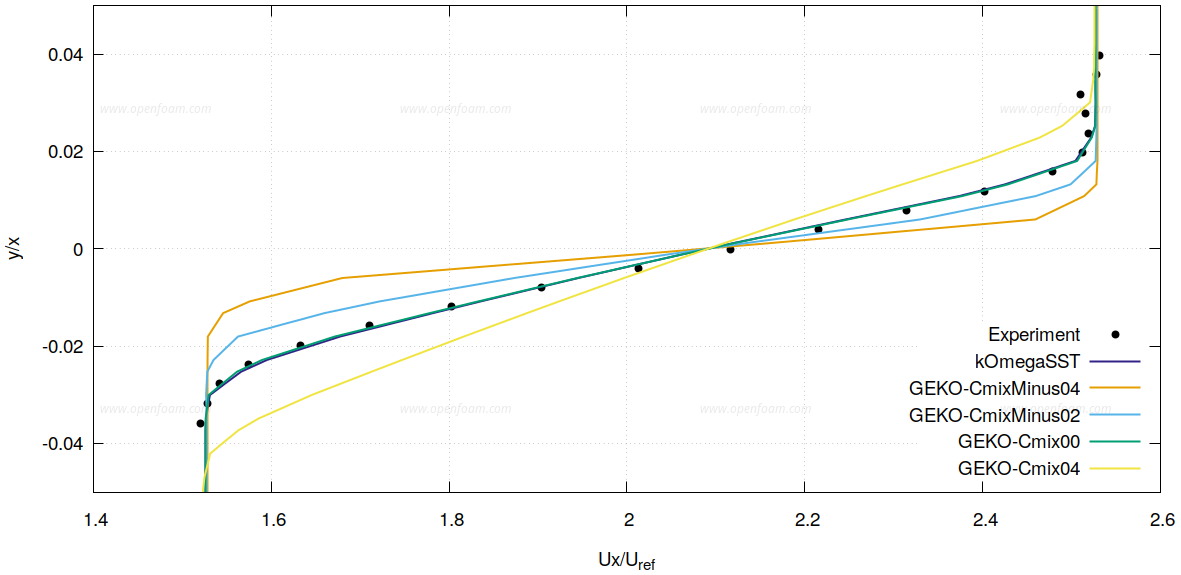
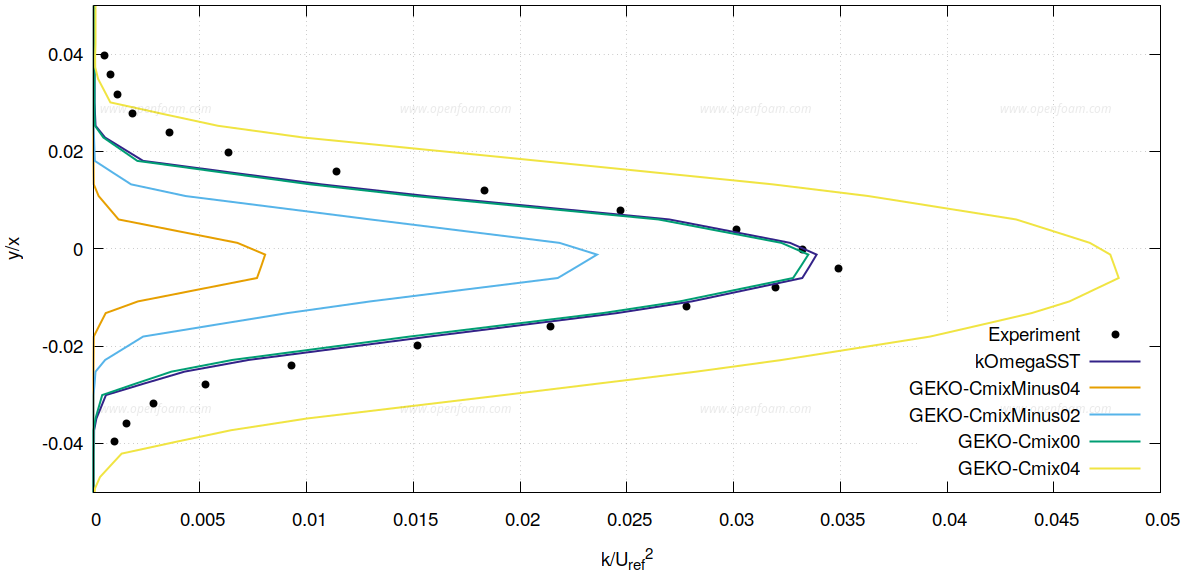
The following plots show the effect of varying CMIX on the self-similar velocity and turbulent-kinetic-energy profiles for the mixing-layer flow:
Source code
Merge request
References
    Menter, F. R., & Matyushenko, A. (2025).
    Generalized k−omega (GEKO) Two-Equation Turbulence Model.
    AIAA Journal, 63(11), 4590-4606.
    DOI:10.2514/1.J065678
TOP
OpenFOAM already provides Bai-style spray impingement physics through the splashBai interaction in the kinematicSurfaceFilm surface-film model. That pathway couples droplet-wall interaction to a resolved or modelled liquid film on the wall, which is appropriate when film dynamics matter but adds modelling and setup overhead when only direct parcel-wall impingement is needed.
The BaiGosman interaction type has been added to the localInteraction patch-interaction model, based on the Bai-Gosman spray impingement framework (Bai & Gosman, 1996). It exposes the same class of adhesion, rebound, and splash outcomes on a patch-by-patch basis for thermo, reacting, and spray Lagrangian clouds, without requiring surfaceFilmModel to be enabled.
The implementation provides:
- Per-patch
BaiGosmantype inlocalInteractionCoeffs. - The parcel type must expose
T()andrho(), and the cloud database must registerSLGThermowith at least one liquid component. - Temperature-dependent regimes: below
Tmelt, viscoelastic rebound or adhesion; aboveTmelt, Weber- and Ohnesorge-gated splash with dry- or wet-wall treatment controlled by thedryswitch. - Secondary splash parcels: stochastic diameter distribution, sampled splash direction, and immediate injection into the owner cloud.
A wall patch can be configured as follows:
localInteractionCoeffs
{
    patches
    (
        walls
        {
            type            BaiGosman;
            dry             true;
            Tmelt           400;
            Wec             200;
            parcelsPerSplash 5;
            Adry            2630;
            Awet            1320;
            Cf              0.7;
        }

        outlet
        {
            type escape;
        }
    );

    ...
}
The model reproduces the Bai-Gosman impingement regimes of adhesion, rebound, and splash. Secondary splash droplet energetics use the wall-normal incident kinetic energy, consistent with the formulation applied to ThermoSurfaceFilm.
Source code
- $FOAM_SRC/lagrangian/intermediate/submodels/Kinematic/PatchInteractionModel/LocalInteraction/BaiGosman.H
- $FOAM_SRC/lagrangian/intermediate/submodels/Kinematic/PatchInteractionModel/LocalInteraction/LocalInteraction.H
Merge request
References
    Bai, C. & Gosman, A., (1996).
    Mathematical Modelling of Wall Films Formed by Impinging Sprays.
    International Congress & Exposition, Detroit, Michigan, United States.
TOP
The turbulentDigitalFilterInlet boundary condition generates synthetic turbulence-like inlet time series for LES and DES using the digital-filter method (DFM) or the forward-stepwise method (FSM). The convolution that embeds two-point correlations is performed inside IntegralScaleBox. In the previous implementation, random-field generation and convolution ran only on the master MPI rank, which made that step a serial bottleneck in parallel runs.
The convolution in IntegralScaleBox has been parallelised so that generation-plane work is distributed across MPI ranks. Existing dictionary syntax is unchanged and simulation output remains consistent with the serial implementation. An optional seed entry can be used to control reproducibility across restarts and mesh redistribution.
The change eliminates the single-processor convolution bottleneck and delivers approximately 15%-35% speedup of the turbulentInflow tutorial simulation.
Source code
- $FOAM_SRC/finiteVolume/fields/fvPatchFields/derived/turbulentDigitalFilterInlet/IntegralScaleBox
- $FOAM_SRC/finiteVolume/fields/fvPatchFields/derived/turbulentDigitalFilterInlet
Merge request
TOP
The pureZoneMixture model in thermophysicalProperties allows cell-zone-specific thermal properties to be defined. In this release, a bug in the heat flux formulation for solid solvers (solidFoam and conjugate heat transfer solvers) has been corrected.
For solids with isotropic thermal conductivity, harmonic interpolation should be used in the laplacian schemes for alpha and kappa to obtain a consistent heat flux at the interface between two cell zones with different material properties, e.g.:
laplacianSchemes
{
    laplacian(alpha,h)      Gauss harmonic limited corrected 0.5;
    laplacian(kappa,h)      Gauss harmonic limited corrected 0.5;
}
For solids with anisotropic thermal conductivity, alpha and kappa are tensors and the harmonic interpolation scheme is not directly available. Linear interpolation should be used instead:
laplacianSchemes
{
    laplacian(alpha,h)      Gauss linear limited corrected 0.5;
    laplacian(kappa,h)      Gauss linear limited corrected 0.5;
}
To ensure a consistent heat flux at the interface between two cell zones, the solver automatically applies harmonic interpolation to the face-normal component of the tensors, even when the linear scheme is specified in laplacianSchemes. Linear interpolation is applied to the off-diagonal parts of the alpha and kappa tensors.
Source code
Merge request
Tutorial