

v2512: Plugins
TOP
We are pleased to announce a new repository under the plugins submodule: Research.
The new Research repository has been introduced as a platform for sharing experimental and research OpenFOAM developments that are not yet part of the main OpenFOAM release. It serves as a staging area for work that is incomplete, highly experimental, specialised, or otherwise not ready for the core distribution, while remaining potentially valuable for users and researchers and providing examples of how to develop similar custom applications.
Content in this repository is provided as-is: nothing is guaranteed to be stable, backward compatible, or supported long-term, and APIs/names/behaviour may change without notice, including the removal of components.
Each development is self-contained, typically including code, documentation in README.md or .pdf, and optional test cases.
The initial models of the repository and all the details can be found in the following links:
| Directory | Context | Short description |
|---|---|---|
redistributedResistivityAlgorithm |
Solver | Rhie-Chow interpolation method for porous media |
FastRK |
Solver | Pressure-velocity coupling algorithm based on fractional methods |
PRECISE |
Incompressible solver | Pressure-velocity coupling algorithm alternative to PISO |
HelicalForce |
Lagrangian | Helical motion of parcels around a specified axis |
TOP
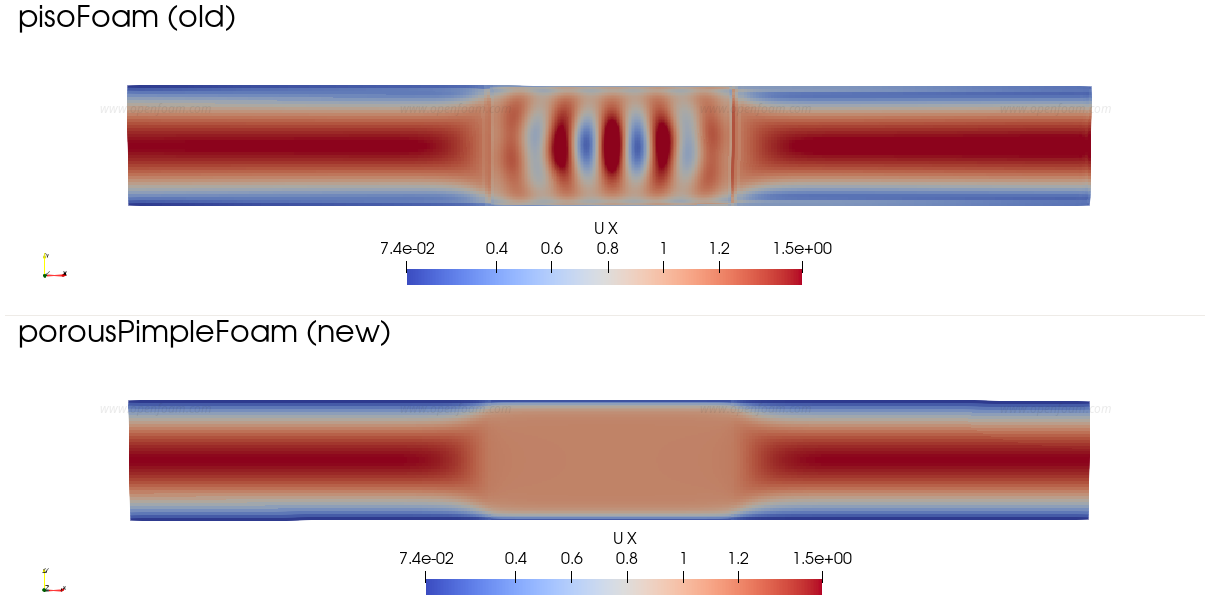
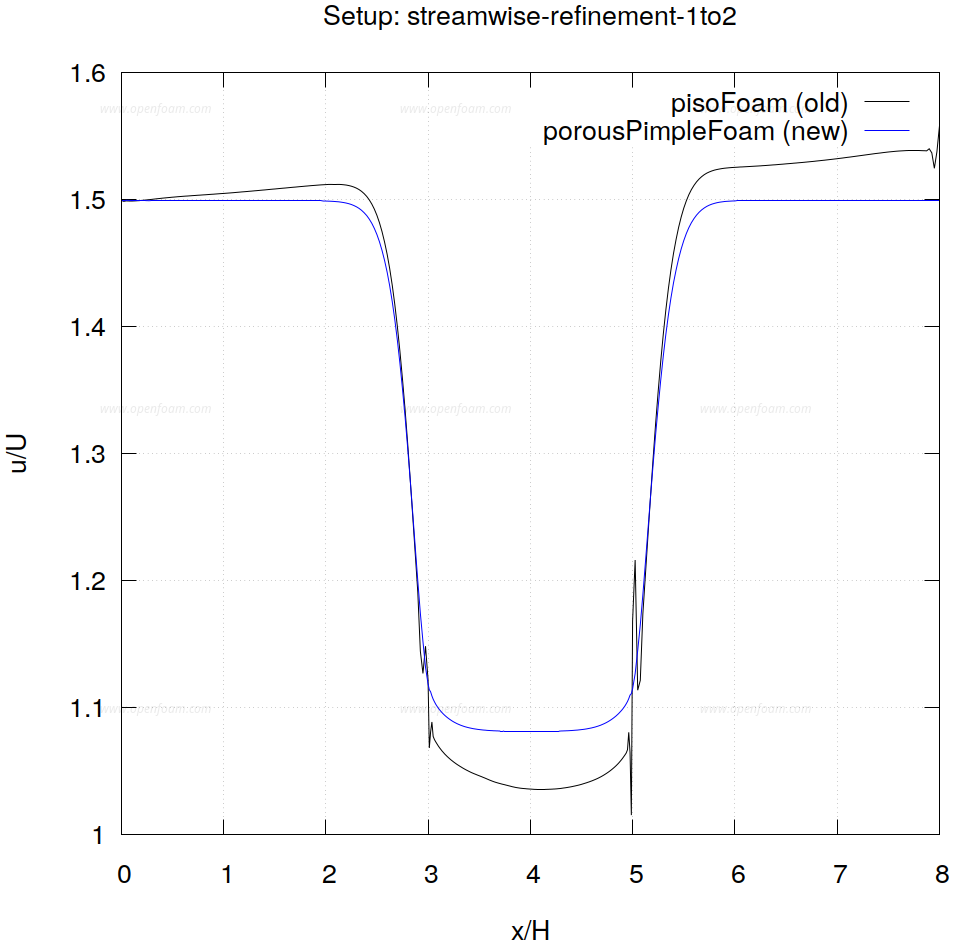
Within the scope of macro-scale porosity modelling of single-phase fluids with computational fluid dynamics methods, a common challenge arises in achieving physically sound numerical solutions near fluid-porous interfaces. Without special attention to the algorithmic development, the presence of discontinuities in material properties, especially porous resistivity, at these interfaces can give rise to undesirable oscillations in the solution.
A promising approach to avoid spurious oscillations near sharp interfaces of fluid-porous domains is the Re-Distributed Resistivity (RDR) algorithm by Nordlund et al. (2016): The original PISO algorithm and Rhie-Chow interpolation method are modified, and an extra step before the predictor step of PISO is introduced where porous resistance is redistributed over cells neighbouring an interface. To avoid time-step restrictions for high Reynolds number and low Darcy number flows, the modelling terms are treated implicitly.
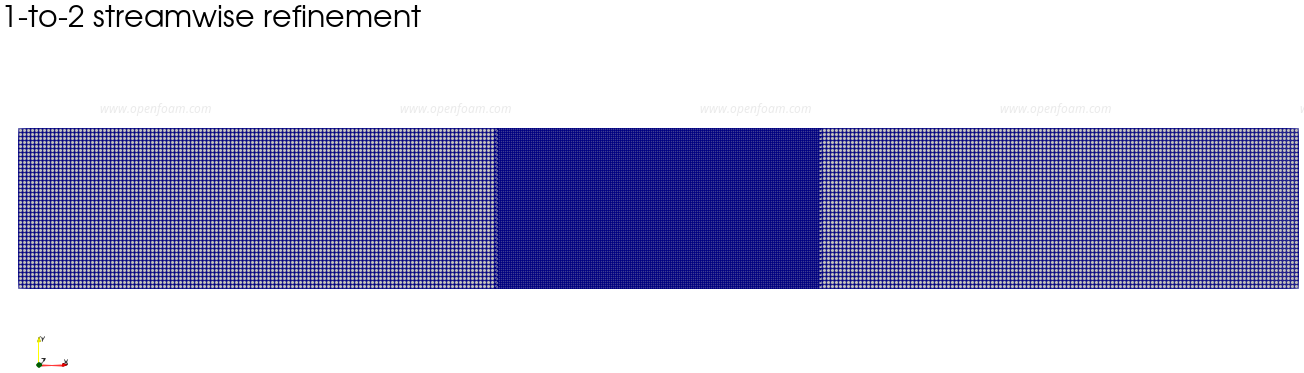
A test using the standard PISO and RDR algorithms for a 1-to-2 streamwise refinement at the fluid-porous interface is shown below (see redistributedResistivityAlgorithm::README.pdf for more tests and full details):
Mesh: 1-to-2 streamwise refinement.
Streamwise flow speed: 1-to-2 streamwise refinement
Centreline streamwise-velocity profile: 1-to-2 streamwise refinement
TOP

For highly unsteady simulations using DES/LES approaches, SIMPLE-like pressure-velocity coupling algorithms were reported to be slow to run.
An alternative family of the pressure-velocity coupling algorithms is identified as the fractional-step (projection) algorithm. The advantage of the fractional-step algorithms over SIMPLE-like algorithms is reported to be their favourable cost properties for large-scale unsteady simulations.
A promising approach named “FastRK” by Karam & Saad (2023) has been implemented: This algorithm family relies on the Helmholtz decomposition of the velocity field into solenoidal (divergence-free) and irrotational (curl-free) components. This approach enables the coupling of pressure and velocity by first computing an intermediate velocity field that does not necessarily satisfy the incompressibility constraint, followed by a projection step to enforce this constraint.
As an example, for the two-dimensional Taylor-Green vortex problem, the following simulation CPU time results were achieved (see FastRK::README.pdf for more tests and full details):
| Solver | tcpu [s] | Difference vs pisoFoam |
|---|---|---|
pisoFoam |
12.47 | - |
RK00 |
7.95 | 4.52 |
RK01 |
18.74 | -6.27 |
RK10 |
19.37 | -6.90 |
RK11 |
26.51 | -14.04 |
RK000 |
9.21 | 3.26 |
RK001 |
18.06 | -5.59 |
RK010 |
20.23 | -7.76 |
RK100 |
15.47 | -3.00 |
RK101 |
23.24 | -10.77 |
RK110 |
25.08 | -12.61 |
RK011 |
26.34 | -13.87 |
RK111 |
31.3 | -18.83 |
CPU time of the solvers
TOP
PRECISE algorithm
In co-located-grid finite-volume applications, the PISO algorithm has been observed to be dependent on time-step and relaxation factor. This is known mainly due to the Rhie-Chow interpolation method.
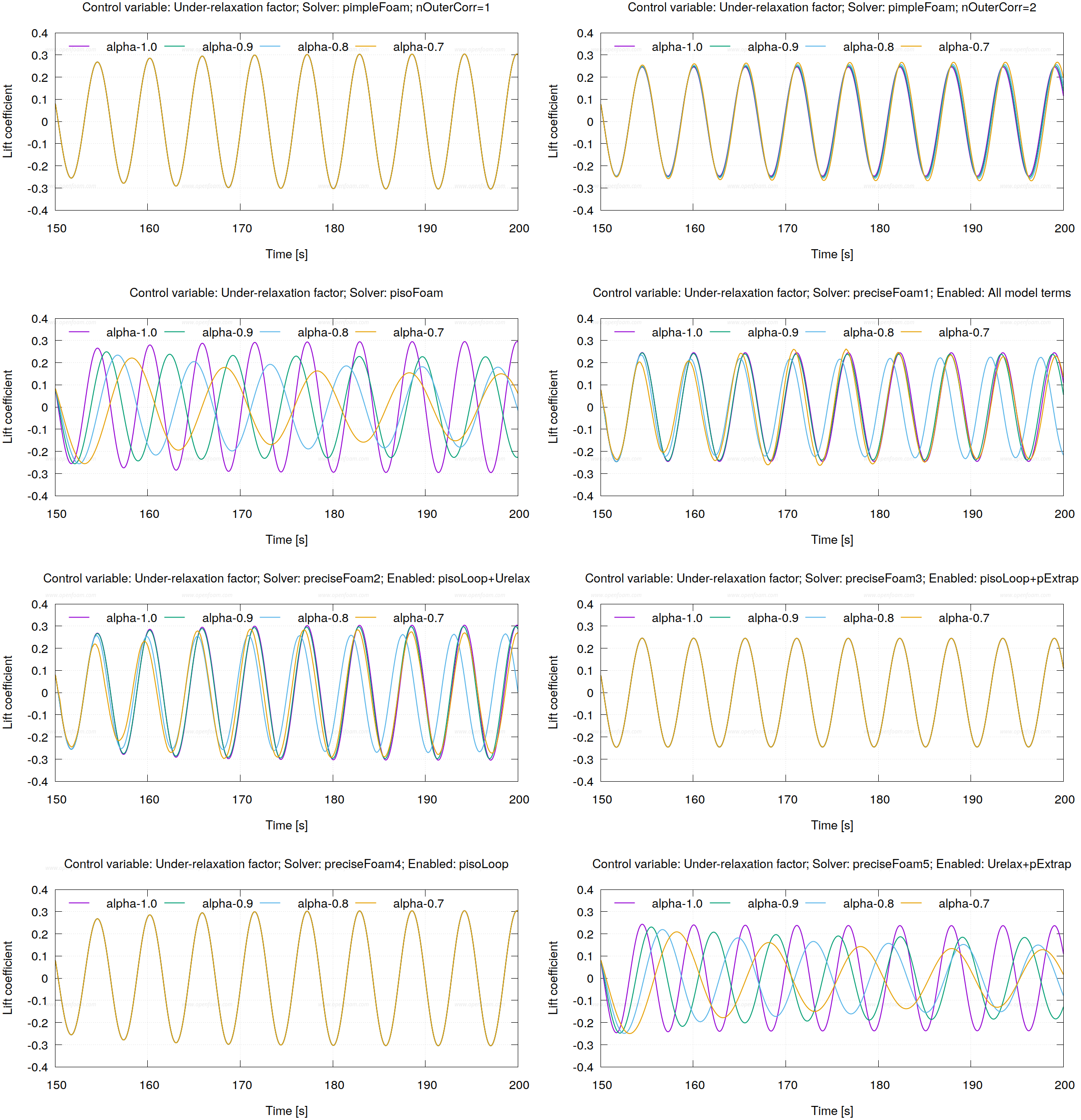
One of the promising approaches among the available methods is the “PRECISE” algorithm (PISO with consistent Rhie and Chow Interpolation and Second-Order Extrapolation) proposed by Ammad et al. (2024). The “PRECISE” algorithm claimed that the time step and relaxation factor dependency of the PISO algorithm has been alleviated, and its behaviour is further stabilised by means of the addition of second-order interpolation units.
The following illustrates the reproduction of the original test case as well as various control studies as a function of under-relaxation factors and time-step sizes (see PRECISE::README.pdf for more tests and full details):
Comparison of the under-relaxation factor effects on the lift coefficient results across solvers
Comparison of the time-step size effects on the lift coefficient results across solvers
Source code
Attribution
- We would like to acknowledge and thank Markus Nordlund, Tony Saad, Ammad Ammad and their colleagues for their valuable contributions and assistance.